Reflections
Talking Mats | Improving communication, improving lives
‘Everyone has the right to make their own decisions’
‘To deny people their human rights is to challenge their very humanity’
Talking about death and funeral planning is challenging and emotional for all of us.
As an Interfaith Celebrant with a background in Special Education, I am very aware that often, people with additional support needs are not given the opportunity to have this conversation, either to plan their own funeral, or to be involved in planning a service for someone close. Frequently, this comes from a concern to protect individuals from grief and loss, and from the distress of contemplating their own death.
However, the impact of preventing this involvement can be significant: the grieving process includes being able to say ‘goodbye’, and being able to participate in, or indeed, to plan, ceremonies and services. Knowing the wishes of our loved ones is so helpful at a time of grief, and it is important that everyone is given the opportunity to have their voice heard, and to be supported to give their views.
Following my experience of using Talking Mats in a special school setting, I worked with Talking Mats colleagues and other celebrants to develop a Funeral Planning set. This was launched in 2024 and consists of 3 conversations:
Funeral Planning – an introductory conversation between an individual and a funeral director, minister or celebrant, to discuss what someone wants or does not want for their funeral.
Funeral Service – a more detailed conversation regarding choices about the actual service.
Eulogy – a conversation which highlights the important themes that someone would want included in their eulogy.
This year, through contact with Compassionate Communities in the Forth Valley area/Strathcarron Hospice, I was asked to work with a group of people who are supported by Key Housing in Falkirk.
The group had taken part in an amazing project, ‘My Wishes, Please Respect Them’, discussing many aspects of death and dying, and I went along to a final group session to explain the Talking Mats Funeral Resource.
Eleven members of the group expressed an interest in planning their own funeral service, using Talking Mats. I met with each person; had the three conversations above, took notes and gave everyone their own booklet with a photo of each Talking Mat and a summary of the notes I had taken.
The age range was from around 35 to around 70, and everyone had different levels of understanding. What was remarkable, was the consistency of everyone’s willingness to have these conversations, demonstrating such courage and openness to talk about their own funeral services. Everyone had a member of their support staff with them: they were all excellent at supporting, only intervening when necessary, and often providing valuable information.
Reflecting on the whole experience leaves me with such a positive sense of the importance of these conversations, and of making sure that support is available to ensure that more people can have them – to ensure that everyone had the right to make their own decisions.
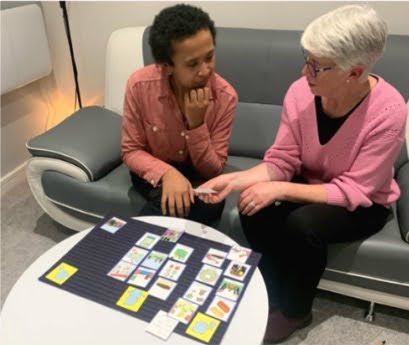
Grateful thanks to Caitlin for giving her permission to use this photograph
The process of a Talking Mats conversation lends itself so well to funeral planning. As the person guiding the conversation, I am the ‘Listener’ and the person making choices is the ‘Thinker’.
Never an easy conversation, rather than talking across a table, we sit side by side, relaxed, the focus on the mat, with open questions and choices being made by the ‘Thinker’ placing the picture card on the mat (for example, what I really want, what I really don’t want, and what I’m not sure about, for my funeral). The pace of the conversation is guided by the ‘Thinker’ with the ‘Listener’ allowing as much time as is needed for choices to be made, and then checking again, if there are any changes to be made.
At the end of the conversation, I took a photograph of the mat, and so was able to ‘record’ wishes which I then included in a booklet.
This is an example of a completed Funeral Service Talking Mat.
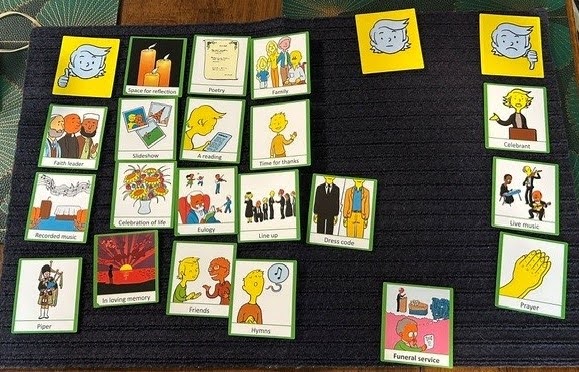
And so, to the conversations themselves. Everyone was at a slightly different stage in thinking about their funerals. Some were very clear about what they wanted: sunflowers, Egyptian cotton to line their coffin, pipes and drums, favourite songs and poems (including ‘Anyone for Tennis’ by Eric Bult). Others were at the early stages of thinking about their services, and the conversations were probably most helpful in deciding what they didn’t want, and stimulating some thoughts on choices around cremations, burials, church services or celebrant-led funerals.
In spite of different levels of understanding, I felt that everyone was clear about the topic and glad to have the conversations, but some responses gave me pause for thought. There was only one person who, initially, was quite hesitant, and appeared to be a bit upset. However, once we were under way, the conversation became easier (talking about favourite music is so helpful!), and I checked regularly that we were OK to continue.
Someone asked me, ‘when will my funeral be?’, I, of course, responded, ‘oh, not for ages!’. This did make me question how we hold conversations about funeral planning, knowing that this person will not be there? But, surely, the only way to plan, is to envisage that they WILL be there, imagining the place, the people, the music etc. and, there’s nothing wrong with that!
In one conversation, I was a bit concerned that, when we recapped and I checked that a piper was indeed wanted, my ‘Thinker’ was just delighted, and my feeling was that he thought that I had just booked one!
Explanations about the difference between a cremation and a burial, a Church and a celebrant-led service, a religious and non-religious service were necessary, and I suggested that visits to a crematorium and to a funeral parlour could help to dispel some of the anxieties that are around not knowing what happens in these places. I very much believe that organising such visits, possibly with friends, create the opportunities to ask questions in a safe and supportive environment, and can lead to wider and easier conversations about death. This is something that is very much encouraged by ‘The D Word’ – a resource that I and some other celebrants have developed for school and community groups.
Any visits that we have organised and facilitated have been very valuable and crematorium staff and funeral directors have always been very welcoming.
When I asked one of my ‘Thinkers’ what they thought of the three conversations, her response was ‘that was fun!’. There is such value in spending time with people, giving them your undivided attention, listening deeply to them, talking about something so special and individual. To know that a conversation about funeral planning could ever be ‘fun’ is quite something, and very rewarding!
For some, their choice was for a Church service, led by a minister, however, in most cases, there wasn’t actually a Church connection, or a minister who would know them.
Speaking with some of the support staff, we discussed the strong possibility that some responses were influenced, either by the perception the ‘Thinker’ had of what the ‘right’ response should be, and/or by their perception of family expectations. This is a challenge: Talking Mats give people the opportunity to express their views, and, in this case their choices and preferences, and there is no way of knowing whether other factors might influence these responses.
It could be that repeating this conversation sometime in the future would result in different choices. The importance of valuing the ‘Thinkers’’ responses is vital. It is also of the utmost importance to remember that the ‘Listener’ is not there to judge in any way at all. This could also be a challenge if choices could incur a significant cost …
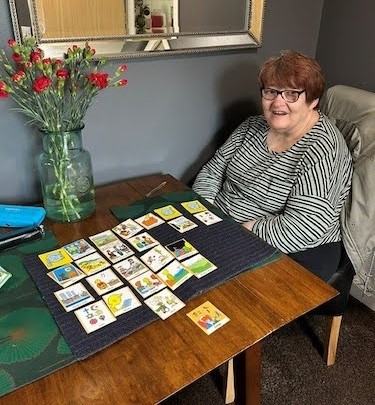
This is Brenda with her ‘Eulogy’ Talking Mat. Brenda kindly gave her permission for this photograph to be shared.
I gave each person their booklet with the record of their wishes for their funerals. This (and an electronic copy) will be kept by Key but could also be shared with Legal Guardians. When the time comes, these documents can be shared with funeral directors/arrangers and Ministers/Celebrants, and decisions about the best way to fulfil the wishes of the person who has died will be taken then.
Knowing these wishes (whether or not they can be fully implemented), goes a long way to easing the challenges of dealing with the grief of loss and making decisions at such a sad time.
This is equally valuable if there are no close family members, and support staff from Key are involved in planning a funeral for someone they have supported.
I am very grateful to everyone in Key for giving me this opportunity – I found the whole experience so valuable, interesting and rewarding. I learned such a lot, and so enjoyed spending time with everyone – thank you all!
Gillian Robertson, September 2026